


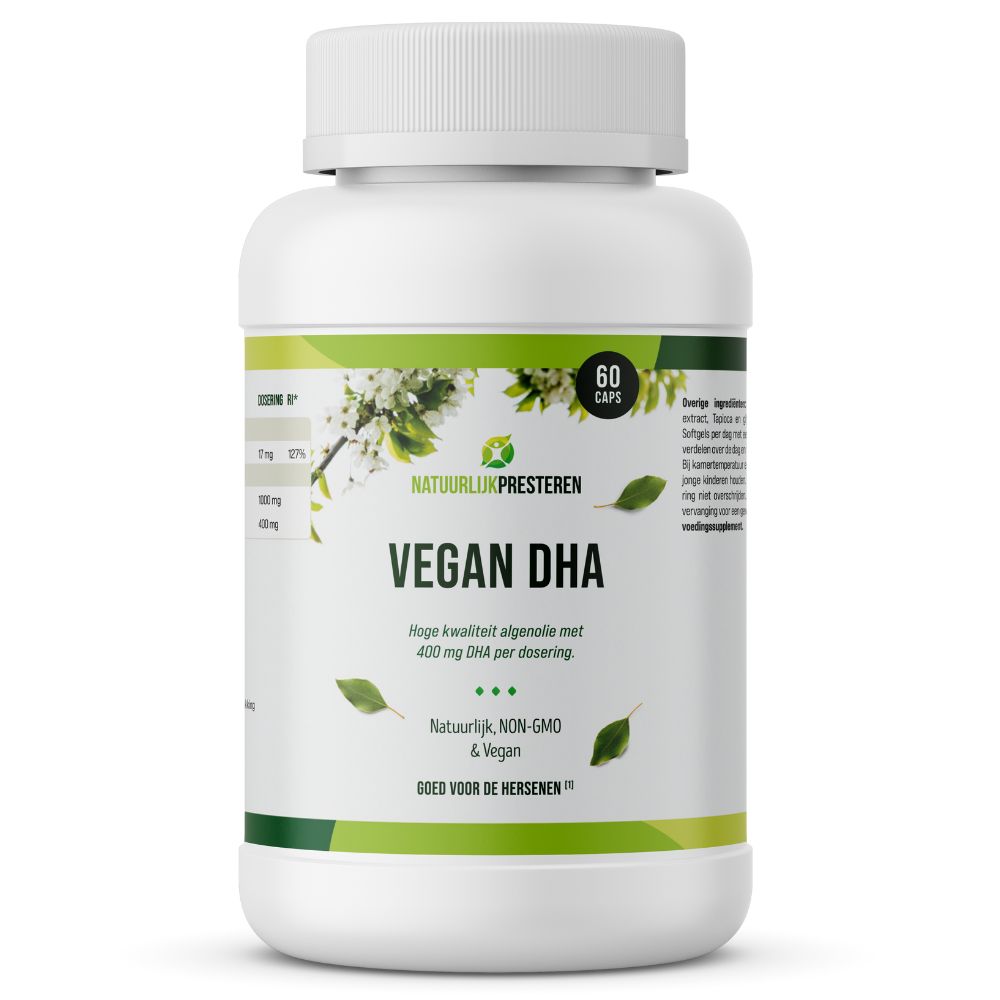
Vegan omega-3 fatty acids
Whether you don't like fish, have a fish allergy, or prefer not to eat animal products for certain reasons, vegan omega-3 is a good alternative to fish oil.
Vegan omega-3 contains the same omega-3 fatty acids as fish, but without the animal origin. It is primarily derived from algae.
Is vegan omega 3 the same as algal oil?
Yes, absolutely. Vegan omega-3 is extracted from algae, the primary source of the essential fatty acids DHA and EPA. It's the same as algae oil, but is often called vegan omega-3.
You'll encounter all sorts of different terms in your search for a good alternative to fish oil. For example, algae oil is also called vegan omega-3 or even vegan fish oil . These are all different names for the same product: algae oil.
About DHA and EPA
DHA (docosahexaenoic acid) and EPA (eicosapentaenoic acid) are polyunsaturated fatty acids, or omega-3 fatty acids.
What's important is that your omega-3 supplements contain both fatty acids . This provides the most health benefits:
- DHA and EPA as a duo is good for your heart and blood pressure , when you get 3 grams daily (or a maximum of 5 if you also use supplements).
- DHA on its own is also an important building block for your brain and plays a role in the functioning of your retina (eyes) , provided you get 250 mg daily.
Why choose vegan omega 3?
Vegan omega-3 is a great alternative to fish oil, especially for those who don't want to use animal products. Here are three key benefits of vegan omega-3.
-
Just as effective as fish oil
Studies show that omega-3 absorption from plant sources is as efficient as from fish, meaning you can experience the same health benefits without eating fish. -
Sustainable and animal friendly
Unlike fish oil, vegan omega-3 is often derived from algae, a renewable resource. This not only makes it animal-friendly but also more environmentally friendly, as it avoids the ecological impact of fishing. -
Suitable for all dietary requirements
Whether you're vegan, vegetarian, or simply don't like fish, vegan omega-3 is an accessible option for anyone looking to increase their omega-3 intake in a way that suits their lifestyle.
Omega 3 in spirulina and chlorella
Spirulina and Chlorella are two well-known algae that are often used as nutritional supplements, but they do not contain significant amounts of omega-3 fatty acids.
It appears that it is mainly the antioxidants in these algae that are responsible for their health effects. (1)
In short : While Spirulina and Chlorella offer many health benefits, they are not good alternatives to the omega-3 fatty acids you get from algae oil.
What about plant-based omega-3 from flaxseed oil?
Besides DHA and EPA, there is a third well-known omega-3 fatty acid: ALA (alpha-linolenic acid).
It is found in certain vegetable oils, flaxseed, walnuts and chia.
Because ALA must first be converted into DHA and EPA in your body, it is not as directly usable by your body as algae oil or fish oil.
In addition, this conversion is not very efficient. Of all the ALA you take, only 5-10% is converted into EPA and only 1% into DHA. (2)
In short: Algal oil (vegan omega 3) or fish oil are better choices than, for example, linseed oil, if you want to efficiently supplement your omega 3 fatty acids.
Conclusion: Is vegan omega 3 for you?
Vegan omega-3 is an excellent option for those who want to experience the health benefits of DHA and EPA without using fish oil.
Whether you eat vegan or simply want to reduce your animal product intake, algal oil is an effective and sustainable source of DHA and EPA.
Other plant sources such as spirulina, chlorella and flaxseed oil also contain omega-3, but in smaller amounts.
Vegan DHA and EPA from algae oil therefore offer a powerful and environmentally friendly solution.
Sources Used
- Santos, H. O., Price, J. C., & Bueno, A. A. (2020). Beyond Fish Oil Supplementation: The Effects of Alternative Plant Sources of Omega-3 Polyunsaturated Fatty Acids upon Lipid Indexes and Cardiometabolic Biomarkers—An Overview. Nutrients , 12 (10), 3159. https://doi.org/10.3390/nu12103159
- Chen, H., Deng, G., Zhou, Q., Chu, X., Su, M., Wei, Y., Li, L., & Zhang, Z. (2020). Effects of eicosapentaenoic acid and docosahexaenoic acid versusα-linolenic acid supplementation on cardiometabolic risk factors: a meta-analysis of randomized controlled trials. Food & Function , 11 (3), 1919–1932. https://doi.org/10.1039/c9fo03052b